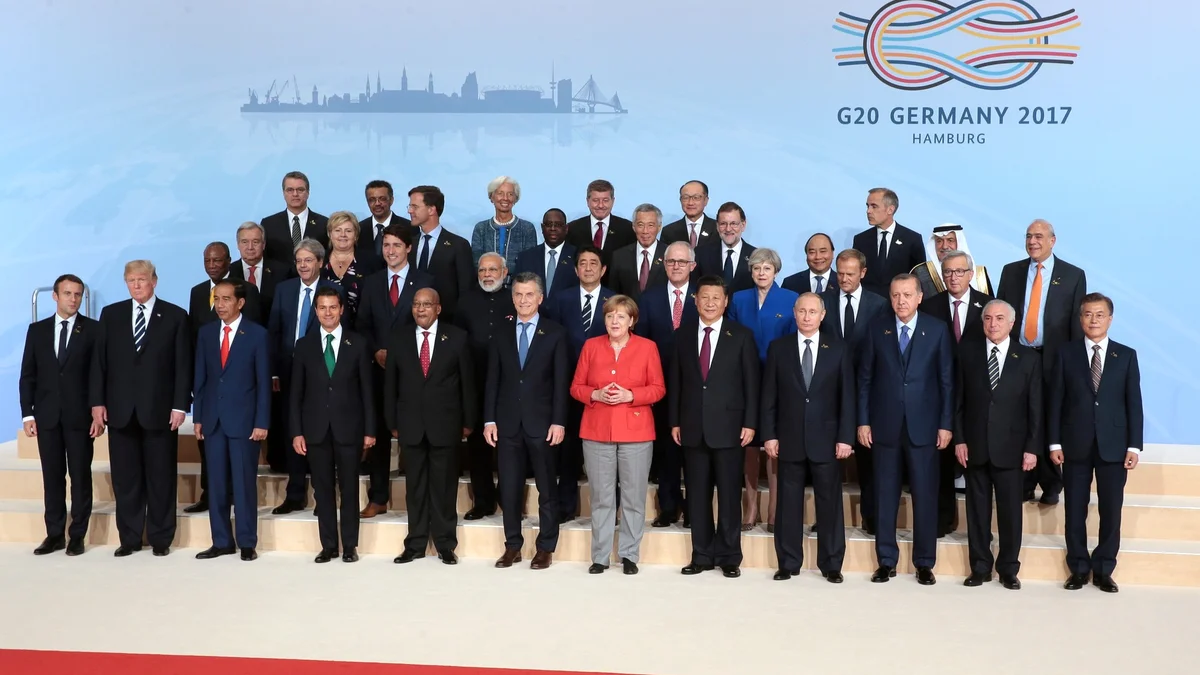
Culminating three days of high-intensity diplomatic maneuvering, financial negotiations, and bilateral compromises, heads of state from the Group of 20 (G20) industrialized nations formally ratified the "Johannesburg Declaration" on Saturday. The sweeping multilateral treaty establishes an unprecedented 180-billion-dollar sovereign debt restructuring architecture, legally coupling institutional sovereign debt relief with measurable capital investments in domestic renewable energy transitions, grid modernization, and climate adaptation infrastructure across the Global South.
Overcoming the Stalemate of Sovereign Default Cycles
For decades, low- and middle-income nations across Sub-Saharan Africa, Latin America, and Southeast Asia have been trapped in an unsustainable fiscal squeeze: paying up to forty percent of their annual sovereign tax revenues to service high-interest foreign debts held by private bondholders and bilateral creditors, leaving zero budgetary headspace to invest in critical health, education, or climate-resilient civil infrastructure. When catastrophic hurricanes, multi-year droughts, or floods struck, these nations were forced to borrow at punitive yields, accelerating a vicious spiral toward national insolvency.
The newly ratified framework, developed in close synchronization with the International Monetary Fund (IMF) and the World Bank Group, fundamentally overhauls the legacy G20 Common Framework. Under the new provisions, countries undergoing sovereign restructuring can automatically convert high-coupon commercial and bilateral debt into long-term, concessionary sovereign resilience bonds featuring guaranteed interest rate caps of 2.1 percent, backed by multilateral credit guarantees from the World Bank's Multilateral Investment Guarantee Agency (MIGA).
Binding Private Creditor Participation
A critical breakthrough in the negotiations—hailed by developing world finance ministers as a structural watershed—was the establishment of legal parity between official state creditors (including the United States and China) and Western private asset managers. Under the treaty terms, private institutional bondholders holding sovereign notes in restructuring nations must accept standardized, equitable haircut schedules and maturity extensions, eliminating the ability of holdout "vulture" funds to sue sovereign debtors in foreign courts.
"Today, the community of nations demonstrated that we can transcend geopolitical rivalry to fix a broken global financial architecture," declared Brazilian President Luiz Inácio Lula da Silva during the closing plenary session. "This agreement ends the indignity of forcing developing countries to choose between servicing foreign debts and protecting their children from rising sea levels and devastating droughts."
The Green Resilience Escrow Facility
Under the terms of the treaty, fifty-five percent of all principal and interest reductions granted to debtor states must be channeled directly into an independently audited "Green Resilience Escrow Facility." These funds will finance domestic solar mini-grids, clean water purification networks, resilient mangrove coastal buffers, and agricultural irrigation upgrades. The United Nations Environment Programme (UNEP) will provide satellite verification to certify that diverted capital directly accomplishes certified emissions reductions and adaptation benchmarks.
The landmark declaration was immediately welcomed by global financial markets, which saw sovereign debt yields for emerging market economies stabilize significantly on international exchanges. With the framework scheduled to take legal effect on January 1, 2027, the first wave of eligible recipient nations—including Zambia, Ghana, Sri Lanka, and Kenya—have already begun assembling preliminary debt-swap portfolios under the historic protocol.